Mahjong rules are easiest to learn as a table routine: four players draw and discard tiles until someone completes a winning hand, often taught to beginners as four melds plus a pair. But there is no single universal rulebook. Guobiao, Cantonese, and American Mah Jongg differ in tiles, scoring, and winning patterns, so agree on a house rule before the first deal.
The table is the first rule
Before scoring, set the table. You need four players, a mahjong set, a flat surface, and one shared rule sheet. Write down the version you are playing and leave it where everyone can see it. Most first-game confusion is not hard strategy; it is two people quietly playing different games.
The tiles: three suits, honors, and optional extras
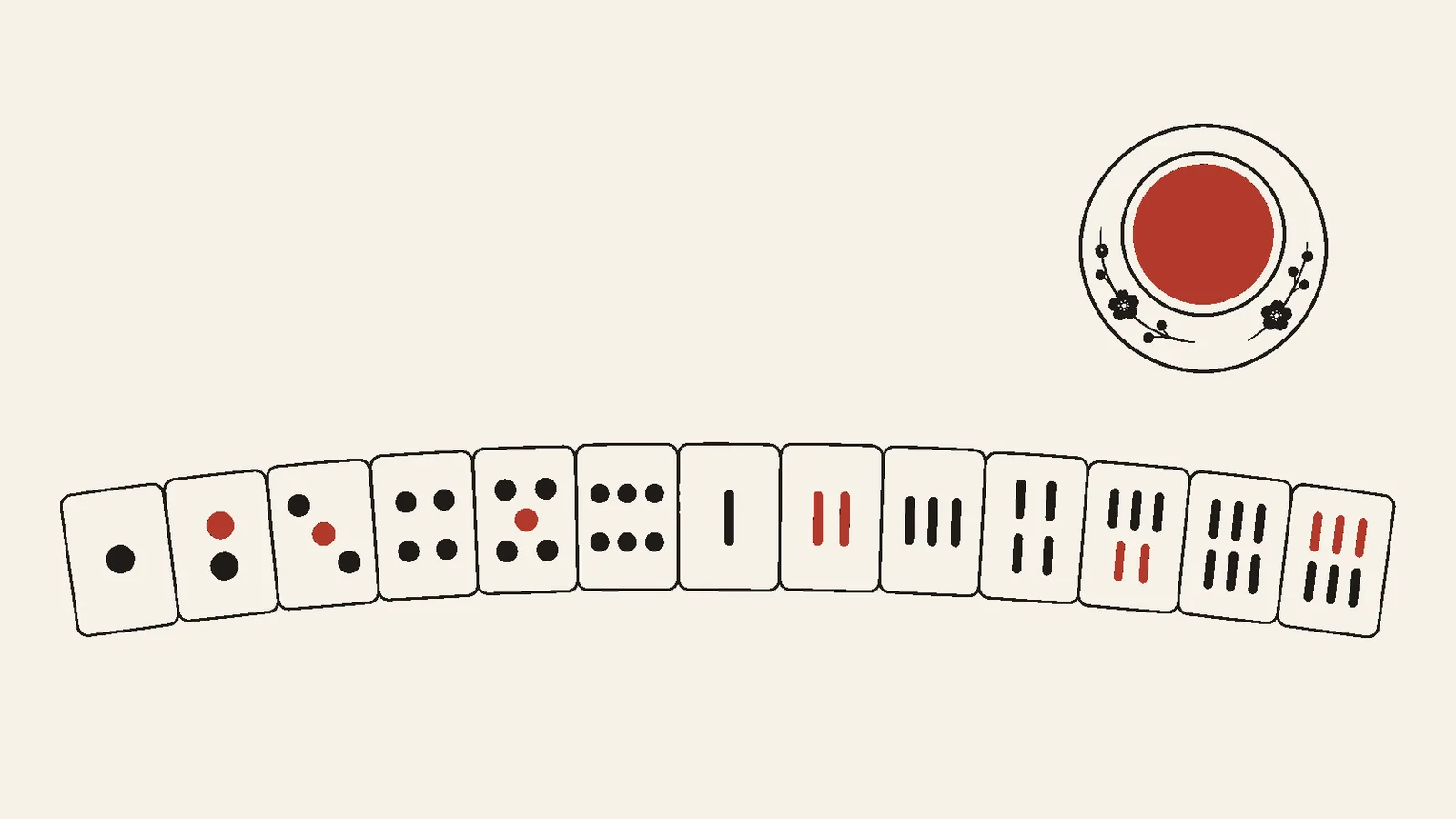
Beginner guides often describe three suits—dots, bamboo, and characters—plus honor tiles such as winds and dragons. Use the labels on your own set; English nicknames and counts vary. Some sets include flower and season tiles; tables handle them differently. Some treat them as bonus tiles, some leave them in the box. American sets may add jokers. Count your set before play and remove anything your rule sheet does not use.
Setup: shuffle, build walls, deal
Turn all tiles face down and mix them gently with your hands. Each player builds a wall segment in front of them; together the segments form a square. For a beginner practice hand, give each player 13 tiles and let the dealer start with 14. That is not every official rule set, but it gets a table moving. The exact deal, dealer rotation, and wall-breaking method belong to your chosen rule sheet.
What to agree on before the first draw
A good house sheet answers six questions: How many tiles are in the set? Are flowers and jokers in play? What is the minimum hand to win? How is scoring counted? Can players claim discards, and which claims are allowed? Who deals next? Five minutes of agreement saves an hour of debate. If your group does not know an answer, choose the simplest option and write it down.
A turn: draw, think, discard
On your turn, draw one tile. Look at your hand. Then discard one tile face up in the middle. Your goal is to improve your hand’s shape: sequences, triplets, and a pair. Some tables let you claim a discard to complete a meld; some restrict claims or require a minimum score. The rule sheet decides. If you are unsure, ask before you touch another player’s discard.
Winning hands: four melds and a pair, with local exceptions
Many beginner explanations teach a winning hand as four melds plus a pair—14 tiles total. A meld is usually a three-tile sequence in one suit or a three-of-a-kind; a kong is four of a kind. The pair is two identical tiles. That shape is a good first target, but it is not the whole story. Guobiao and Cantonese tables may require specific scoring patterns; American Mah Jongg uses a different card of winning hands (National Mah Jongg League rules). Always check the table’s sheet before you declare a win.
Mini glossary for the first hand
A meld is a set of three or four tiles that work together. A sequence runs in one suit, like 3-4-5 dots. A triplet is three of a kind; a kong is four of a kind. The pair is two identical tiles. The wall is the face-down supply. A discard is the tile you throw face up. A wait is the tile or tiles that would complete your hand. Use these words at the table and the rule sheet gets easier to read.
Guobiao, Cantonese, and American Mah Jongg: what changes
Guobiao points to a competition-style Chinese rule set; Cantonese mahjong covers a family of regional table games. They share the draw-discard rhythm and tile feel, but they are not interchangeable. Scoring, allowed hands, and table customs can differ, and local groups often play by their own printed sheet. If someone says “Chinese mahjong,” ask which one.
American Mah Jongg is a separate branch. It commonly uses 152 tiles, including 8 jokers, and follows the National Mah Jongg League’s annual card (National Mah Jongg League rules). American tables often use racks, a card, and jokers, which changes the feel of the turn. The card sets the winning hands for that year. You cannot bring a Chinese four-melds-and-a-pair hand to an American table and assume it counts, and you cannot reproduce the card for a homemade game. Use the current card from NMJL or a legal sample hand from your own materials.
Beginner tips that save the evening
- Agree on one rule sheet before shuffling. Photograph it and keep the photo on the table.
- Play two practice rounds with hands face up. Everyone can see melds, waits, and discards without guessing.
- Put a cheat sheet in the middle: sequence, triplet, kong, pair, win.
- Keep score simple for the first night. Points, snacks, or bragging rights are enough; check local laws if money is involved.
- Announce claims clearly: “I claim this for a triplet.” It prevents table arguments.
A simple first game plan
Use a 136-tile set, or remove flowers and jokers for practice. Deal 13 tiles to each player and 14 to the dealer. Play open-hand for two rounds: no hidden information, everyone helps. The first player to make four melds and a pair wins the practice round. After that, switch to the real rule sheet. This method teaches the rhythm of mahjong without drowning a new player in scoring tables.
Questions, answered
What is the basic goal of mahjong?
Beginner tables often aim for four melds plus a pair, 14 tiles total, but scoring and winning patterns vary. Agree on a rule sheet before play.
How many tiles are in a mahjong set?
Common Chinese sets have 136 tiles, or 144 with flowers and seasons. American Mah Jongg commonly uses 152 tiles including 8 jokers (National Mah Jongg League rules). Count your own set before play.
Is mahjong the same as American Mah Jongg?
No. American Mah Jongg uses an annual NMJL card and often jokers; Guobiao and Cantonese Chinese tables use different scoring and hand patterns. They are different table games with related tiles.
What is a meld in mahjong?
A set of tiles that forms a sequence in one suit or a three- or four-of-a-kind. A basic winning hand is often taught as four melds plus a pair, though local rules may add special hands.
Can beginners play mahjong without gambling?
Yes. Play for points, snacks, or bragging rights. Mahjong is a table game first; check local laws if money is involved, and keep early games friendly.